


While the powers that be continue to debate the definition of “ultra-processed foods,” I’m using this space to illuminate the far greater risk to individual and public health too few people talk about: the global meat-making agrifood system that is factory farming.
Now that you know the stats—92 billion animals are killed every year for human food—you might think to yourself, if you’re a math-y type of person: Wow. That’s a fuck of a lot of animals. Especially since there’s only 8.2 billion sapiens on Earth …? The rate is awfully high, per capita, right? How is that even possible?
Those are the right questions, and we’ll explore the answers and their implications in today’s Substack, the third in this series on agshittification.
Spoiler alert: It’s a result of concentrated animal feeding operations and intensive food processing, by definition, that make that live animal safe, tasty, and nutritious for humans to eat.
And you won’t believe how many nasty things go into it!
I’ll continue with excerpts from my recent book Food and Nutrition: What Everyone Needs to Know, drawing from Chapter 18 (“Making Meat: There’s Nothing Natural About It”) to stimulate critical thought about what is and is not ultra-processed by illuminating three main ingredients used in global meat-making; their impacts; and what it means for eaters like you.
Specifically, I’ll cover each of three topics below and provide examples of each.
Antibiotics » make animals nice and fat, sooner » antibiotic resistance » the next COVID?
Hormones » make even more milk and meat, faster » antibiotic resistance + ecosystem disruption
Processing aids » kills pathogens » make animals safe to eat
Welcome to today’s edition of food truth, unfiltered, where I share the facts on what goes into making industrial meat to encourage you to make up your own mind as to what is “all natural” and “ultra-processed” and what is not, and why it matters.
On planet Earth, ~140,000 chickens are killed every minute, about the amount of time you’ve spent reading so far.
1. Antibiotics: an Everyday Ingredient
A Public Health Marvel
We’re all familiar with antibiotics, which are used to treat common infections. They are also a scientific marvel, used routinely in medicine, including surgery and childbirth. A world without effective antibiotics takes us back almost a century, punctuated by the 1928 discovery of a mold we now know as penicillin. It was first used to treat syphilis (1928) and then streptococci (1940), then soldiers during World War II (1940s). Penicillin was mass-produced in the US and available for public use, contributing to a 23-year increase in lifespan enjoyed by Americans.
Got that? More than 20 years of life were added as a result of the scientific discovery, biomedical invention, and widespread availability of antibiotics to everyday people like you and me.
So what’s this got to do with my spicy buffalo chicken wings and blue cheese, you ask?
Antibiotics on the Menu
Antibiotics are literally added directly to animal feed. Which is analogous to an “ingredient” to me, if not an “additive.” Even if you just call it what it is, a pharmaceutical, including antibiotics in everyday meals certainly doesn’t seem “natural” to me.
In the US, antibiotics are fed mainly to cows, chickens, and pigs. The practice began in the mid-twentieth century and may be medically necessary in limited situations, like when animals are sick and require pharmacological intervention.
Same as our own species, right?
Yet—get this—around 80% of antibiotics in the United States are not used in medicine for human health, but in factory farming to make meat. And it has nothing to do with treating bacterial illness.
The main reason is that antibiotics are used as “growth promoters.” Doping animal feed with antibiotics means animals get bigger, faster, which means they’re off to slaughter, sooner. As a result, your cow costs less to make into beef; it’s more efficient, from a production standpoint.
Antibiotics are also used prophylactically to combat the high risk of disease resulting from crowded and unsanitary conditions on factory farms. See previous: antibiotics are added to the feed, this time under the Big Ag misinformation that it will keep them healthy (thereby limiting their cost of producing your burger).
There is little evidence supporting the effectiveness of antibiotics in preventing an infection. The practice does, however, contribute to antibiotic resistance, not only in the drugged-up animals force-fed them, but also in the species that eats them: humans.
How Factory Farming Makes Superbugs
When antibiotics are overused, by whatever animal is becoming your meat, the bad bacteria they are designed to wipe out can instead become resistant, reproduce, and multiply. The result is a highly virulent “superbug.” These antibiotic-resistant superbugs can then be transmitted to sapiens handling and consuming meat. They can also reach non-meat eaters’ plates via contamination from animal manure, which seeps into water and land.
Reminder: it’s not the antibiotics themselves that pass through the animals and on to you. The antibiotics are metabolized prior to slaughter, with negligible residues of the drug itself. What gets to your plate is the very smart microbes who finally outwitted the antibiotic used to make your pork chop plumper—and it just may be our species’ undoing.
Antibiotics also disrupt the soil’s natural balance of microbiota, turns out, and antibiotic-resistant genes have been detected in some agricultural land.
The result is a cycle where antimicrobial-resistant (AMR) bacteria pass between soil, plants, and animals as a result of antibiotic misuse in factory animal farming.
In time, antibiotics commonly used in human medicine may become ineffective, increasing the risk of serious illness, disease, and death from otherwise treatable infections.
The CDC estimates that drug-resistant infections could kill up to 10 million people a year by 2050, which is more than the roughly 7 million lives COVID-19 claimed worldwide—across the entire pandemic.
Perhaps you have trouble connecting your chicken salad as a potential cause of death. So here’s an exemplar, familiar to many biological females of the species, and some men, too: the dreaded UTI, or urinary tract infection.
Antibiotic Resistance: Death by UTI?
UTIs are uncomfortable and painful and not infrequent—and are increasingly difficult to treat due to widespread antibiotic resistance of the bacteria causing the infection. As well, many different strains of bacteria can cause similar symptoms, so it’s super important to get the right antibiotic to treat the microbe giving you pain.
If untreated, or unresponsive to the prescribed antibiotic—which may happen with multiple drugs—the infection continues to invade the urinary tract, moving through the bladder and traveling up to the kidneys.
If available, your healthcare provider will try and stop the progression with another course of antibiotics, hoping it will kill the superbug killing you.
No.
No other antibiotics work, and you die on the table in total kidney failure from what used to be an easily treatable infection knocked out by a round of antibiotics.
The very life-saving technologies humans created to give us longer life no longer work because we’re misusing that same powerful medicine to make your chicken breast nice and big.
At least 2.8 million people every year develop an antibiotic-resistant infection, and in more than 600,000 of those cases it was due to something they ate.
Rising Antibiotic Use and Resistance
The fact is that antibiotic resistance is a direct result of factory farming, according to the US Centers for Disease Control and Prevention (CDC) and other national and international bodies. Abuse in the healthcare industry and overuse in plant crops, if you can believe it, also contribute.
Despite this serious threat to public health, antibiotic use in Big Ag is expected to rise ~70% worldwide by 2030. It’s largely due to the rise of megafactory farming in places like China and India emulating oh-so-efficient American practices, though it’s happening around the globe.
In the Philippines, for instance, AMR is rising alongside the growing poultry industry: Antibiotic-resistant (AR) genes have been found in both the animals and the farms where they are produced. Strikingly, the data showed that AR genes were present even in meat raised without antibiotics due to transmission via manure.
If you choose to eat meat, opt for antibiotic-free to ensure your own immune system can fight for you when needed; you’ll be helping out other species and our planetary home, too.
Alternative Agrifood Systems Exist
The good news is that there are many different models, alternative agrifood systems that make meat without everyday antibiotics. A 2017 review of 181 studies, for example, found that interventions that restricted or prohibited antibiotic use—like organic farming, vaccines, reduced concentration (crowding), and improved sanitation—lowered antibiotic-resistant bacteria as much as 39% in animals and 24% in humans. The strong and consistent scientific evidence led the World Health Organization (WHO) to urge Big Ag to:
Stop misusing antibiotics for growth and disease prevention.
Treat sick animals only with the least important antibiotics to human health, not highest priority or critically important drugs.
So, perhaps you might consider cutting back on animal foods—or, at the very least, choose those made without antibiotics.
2. Hormones: an Everyday Ingredient
Unlike antibiotics, hormones are used only to make food from cows or sheep, not chickens or pigs. As with our own species, hormones are anabolic drugs that are consumed to enhance growth rate and muscle weight. In cows, hormones are added to increase so-called “feed use efficiency,” a key metric used in factory farming that captures the rate of converting that animal into meat and milk.
In the US, the Food & Drug Administration (FDA) has been allowing steroid hormones (e.g., estrogen, progesterone, testosterone) to boost meat and milk production since the 1950s. This involves periodically implanting hormone pellets into a cow’s ear, and the practice is widely used in Canada, Australia, and around 30 other countries.
A well-known example of hormones used to produce milk is in dairy cows. Recombinant bovine somatotropin (rBST; a.k.a. bovine growth hormone, or rBGH) is given to cows to increase milk production, resulting from increased stimulation of insulin-like growth factor (IGF-1).
As with antibiotics, animals fully metabolize these hormones before slaughter, virtually eliminating the probability of reaching humans. Plus, hormones have been used for decades, and scientific studies show no significant difference in milk from BGH-treated versus untreated cows.
What is significantly different, however, is the higher levels of IGF-1 measured in the milk you drink and meat you eat from cows that have been given hormones—between 2x and 5x higher.
Who cares, you ask?
Well, it could be a cause of cancer in humans—maybe. The scientific research is clear that high IGF-1 has been shown to enhance tumor growth. At least, in studies in vitro (cells in Petri dishes) and in vivo (live animals). Evidence in humans for such an effect, however, is inconsistent and sparse. It’s a difficult question to study and the American Cancer Society has no position on whether milk causes cancer. (There’s a lot more to say on dairy and disease, and some choices are better than others, a topic for another day.)
Hormones Feed Antibiotic Resistance
Dairy cows given hormones are more efficient (note the theme), producing about 15% more milk. This higher-than-normal milk production leads to increased suffering of the animals making it, however, largely due to chronic mastitis, a painful udder infection. The US Humane Society and the Humane Farming Association oppose the use of rBST in dairy cows for this reason and others.
Moreover—wait for it—recent studies have reported that the regular use of antibiotics to treat mastitis due to hormones have, as a result, led to antibiotic-resistant bacteria. Hormone residues can also end up in soil and wastewater, where they can act as endocrine-disrupting environmental pollutants that impact the broader ecosystem. Observed effects include disruptions in reproduction in both land invertebrates and fish, as well as compromised plant life.
While FDA approved rGBH in 1993, and it’s still used in the US, it is prohibited in the EU. The EU also bans the import of hormone-treated milk or meat. The American Public Health Association and other organizations also oppose the use of hormones in the agrifood supply.
Nevertheless, the US Department of Agriculture’s current policy is:
Hormones may be used to promote efficient growth. Estradiol, progesterone, and testosterone (three natural hormones), and zeranol and trenbolone acetate (two synthetic hormones) may be used as an implant on the animal’s ear. The hormone is time released and is effective for 90 to 120 days. In addition, melengestrol acetate, which can be used to suppress estrus, or improve weight gain and feed efficiency, is approved for use as a feed additive.
As with antibiotic-fed meat, go for animal foods made without added hormones. Not because it’s terribly risk to your own health, likely, but because it’s unnecessary; it reduces the spread of antibiotic resistance; and it’s one step towards less suffering in the world.
3. Processing Aids in Animal Food Production
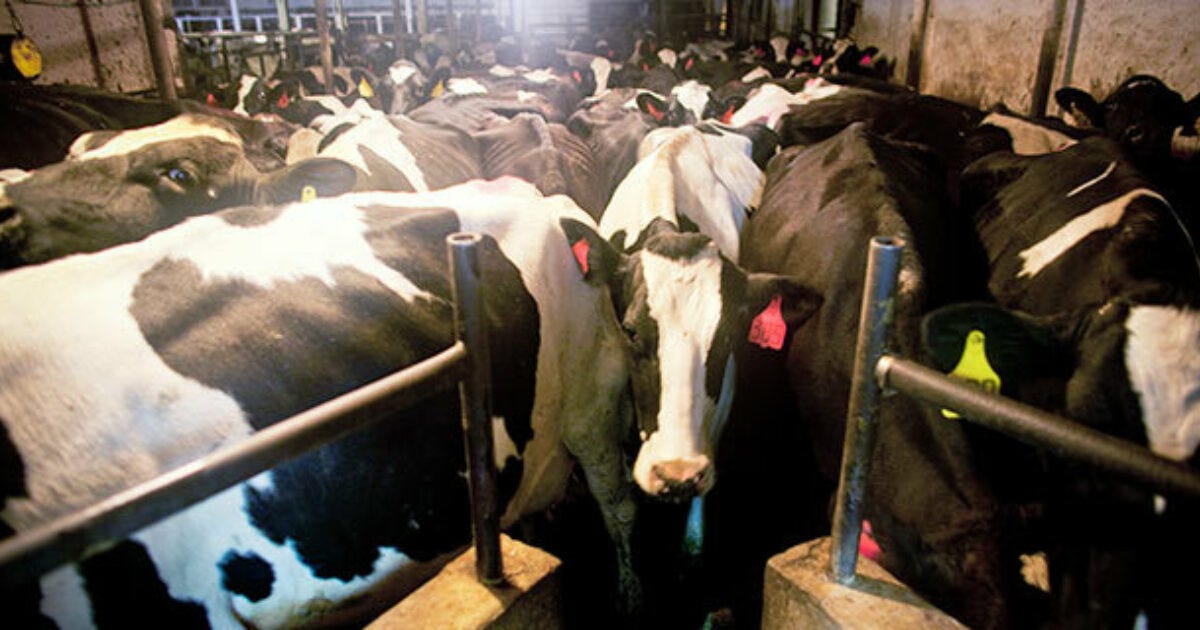
There’s a whole lot of steps involved to get those live animals made into human food, and much of them involve blood, flesh, bones, body parts, organs, feces—and potentially lethal pathogens.
That’s why there are so many processing aids used in animal food production, the final topic of this essay. Here, peruse this 65-page spreadsheet of “Safe and Suitable Ingredients Used in the Production of Meat, Poultry, and Egg Products - Revision 61” from May 2026, perhaps. Or glimpse this list of “Approved On-Line Reprocessing (OLR) Antimicrobial Systems for Poultry.”
Processing aids comprise a large group of chemicals (gasp!) used in food processing of all kinds, for all sorts of reasons, animals and plants alike. They are, in food safety legalese, a subset of “incidental additives.” Incidental additives are “present in a food at insignificant levels and do not have any technical or functional effect in that food,” according to the Food Safety & Inspection Service (FSIS) of the USDA.
The verbiage is dry, but, as language is at the heart of this matter, and since this info isn’t easy to find, the US Code of Federal Regulations defines processing aids as substances meeting one of three criteria:
Substances that are added to a food during the processing of such food but are removed in some manner from the food before it is packaged in its finished form.
Substances that are added to a food during processing, are converted into constituents normally present in the food, and do not significantly increase the amount of the constituents naturally found in the food.
Substances that are added to a food for their technical or functional effect in the processing but are present in the finished food at insignificant levels and do not have any technical or functional effect in that food.
It’s a bit abstract, I know, and a bit boring, so let’s get specific since we’re talking about animal food processing aids in particular.
Animal Farming is Filthy
I’m sure there are pristine megafactory farms.
Actually, I’m not sure.
Point is, my subhead refers not to a factory farm’s cleanliness as such, but to its very business model of making living beings en masse into human food in the manner in which we do.
And that’s why antimicrobials are one of the major processing aids used throughout the meat-making process, highlighted here. The whole system is teeming with pathogens, whether from live animals, dead animal carcasses, raw meat, or ready-to-eat meat, and different chemicals are used to control them in factory farming.
A prime example comes from the Food Safety and Inspection Service of the USDA FAQ, which reads:
“How is Beef Treated in a USDA-Inspected Plant to Reduce Bacteria?”
The following methods have been extensively studied and found effective in reducing bacterial contamination on a beef carcass: organic acid washes, water washes, steam pasteurization, steam vacuuming and other antimicrobials.
Okay.
Peracetic acid, chlorine, and organic acids are often used in chicken and pig farming as well.
It’s gross, you realize?, sick and dirty and suffering animals slaughtered at the hands of humans and machines, the result an unimaginable carnage teeming with pathogens, from factory farm to slaughterhouse floor to meatpacking plant.
You better believe—and hope—that powerful antimicrobials are used to ensure that animal meat is all nice and clean and ready for your skillet!
Are you surprised to learn about all these chemicals used to sanitize slaughtered animals so you can eat them safely?
How do you feel about it?
Is anyone even still reading?
You now know that processing aids do not need to be on food labels, since they have met the criteria earlier described and FDA has deemed them “Generally Recognized as Safe” (GRAS).
And—to be clear—they are safe. Especially relative to other risks us humans take in our daily lives. Seriously. Many processing aids are simply used to kill foodborne microbes, which pose a far greater risk to your health than not using an antimicrobial processing aid.
(Other than not eating it at all, that is.)
I’m a scientist, remember? And everything is chemistry.
We are really lucky to live in a country with stellar food safety, all things considered. (With apologies to those shitting their pants rn).
(sips glass of dihydrogen monoxide and citric acid)
The point is not that processing aids aren’t safe.
The point is that Big Ag, despite all this (and so much more) gets a big fat “natural” label slapped on it, which is permitted under USDA as follows:
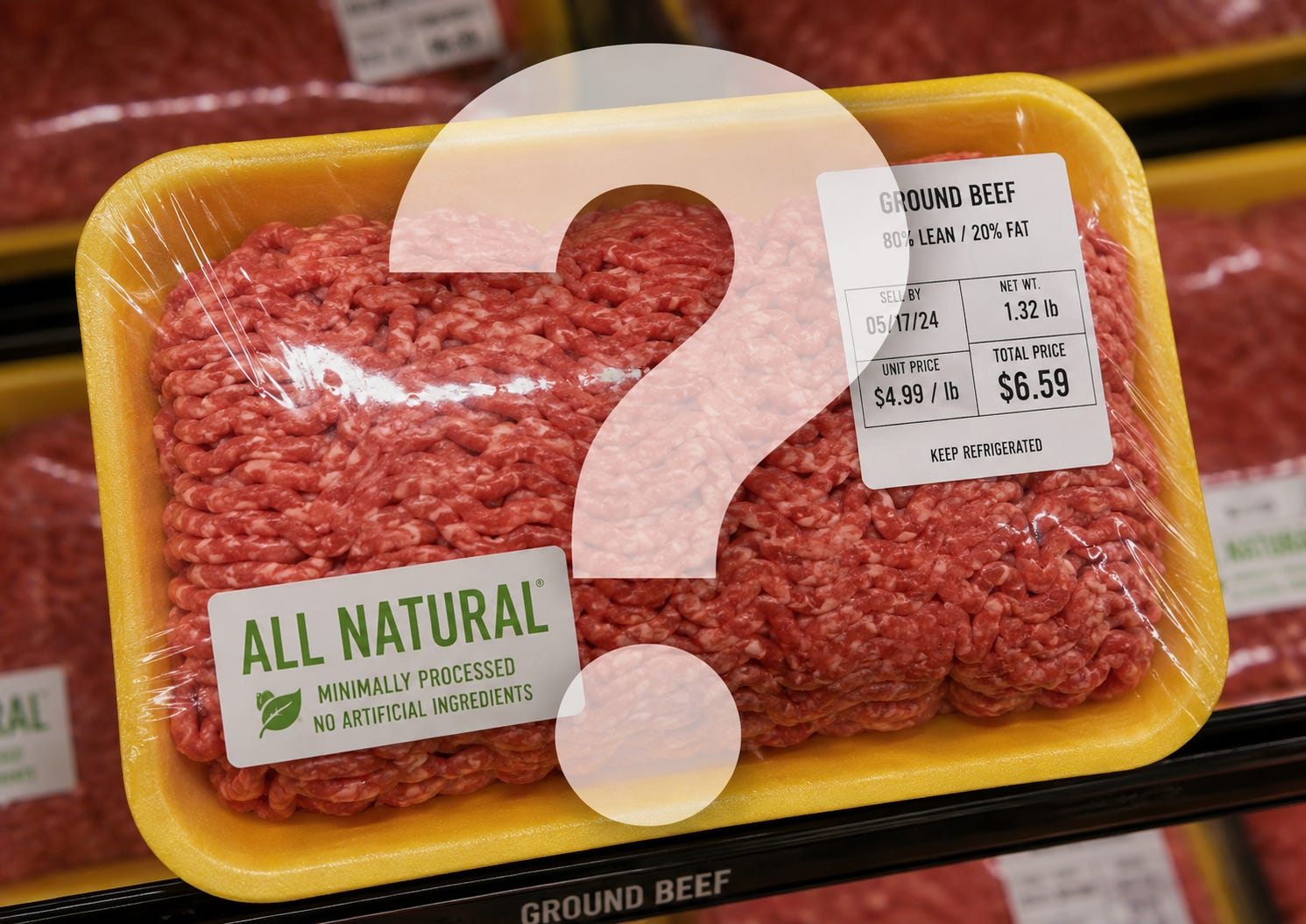
All fresh meat qualifies as “natural.” Products labeled “natural” cannot contain any artificial flavor or flavoring, coloring ingredient, chemical preservative, or any other artificial or synthetic ingredient; and the product and its ingredients are not more than minimally processed (ground, for example).
Question:
From what you’ve learned so far, does making animal foods like meat and milk sound like it meets the definition of “minimally processed”? Or “natural”?
Contemplate, and bear with me for this final example that took me rather by surprise: pink slime.
Pink Slime, Then and Now
Some readers may vaguely recall a little something called “pink slime.”
Ring a bell?
It’s likely been repressed, if not forgotten, in the many years since it got major attention back in 2012, now a million years ago.
Pink slime is the colloquial phrase assigned to what is known by Big Meat as “Lean Finely Textured beef,” or LFTB.
According to a 2012 Congressional report titled “The Pink Slime Controversy”:
LFTB is a beef product developed by Beef Products, Inc. (BPI), in 1991 to provide more domestic lean beef. BPI purchases beef trimmings, mostly 50% lean or less, from USDA-inspected beef processing plants, heats the trimmings, and sends them through a centrifuge process that separates the fat and the meat. The resulting product is LFTB that is 94% to 97% lean beef, according to BPI. In addition to developing the process to extract the meat from beef trimmings, BPI developed a process that uses ammonium gas (anhydrous ammonia) as an antimicrobial intervention directed primarily at E. coli O157:H7, but also effective on Salmonella. The ammonium hydroxide antimicrobial process, called pH enhancement by BPI, was approved by USDA in 2001.
During the production process, BPI treats the LFTB with food-grade ammonia gas; the gas mixes with water in the meat and creates ammonium hydroxide, which in turn raises the pH level in the LFTB and kills pathogens. After the ammonium hydroxide treatment, the LFTB is quick-frozen and pressed. LFTB is then ready to be combined with beef trimmings to produce ground beef. LFTB is often combined at 10% to 20% by volume of the ground beef, depending on the specifications of the end users. LFTB is widely used as a way to boost the leanness of meat products. Besides ground beef, LFTB is also used in other products such as lunch meats, sausage, and canned meats.
You can read all about the brouhaha over at Wikipedia, which led to public outrage for a minute—and seriously damaged BPI and burger sales for a few years.
Then, following multiple lawsuits against ABC (for their pink slime exposé), a clever “Dude. It’s Beef.” campaign by BPI, food tech improvements, and (I presume) aggressive lobbying, a change in legislation made the whole slippery thing go away.
In 2018, Lean Finely Textured Beef was simply reclassified as “100% ground beef” by the Food Safety and Inspection Service of the United States Department of Agriculture.
Problem solved!
Hey, I wouldn’t worry about it! Seriously!
Whatever you choose to call it, LTFB has been found to be safe. It really is just beef. And I like—nay, love!—the fact that, through this sophisticated process scavenging then centrifuging cow parts from the meatpacking floor, BPI can get every last bit of edible flesh it can.
Because that means fewer cows are born, live, and die to be made into meat.
That’s a big win, in my book.
A huge win.
I just wouldn’t call it “minimally processed” and place an “all natural” label on its package.
Would you?
The Myth of “All Natural” Meat
Perhaps I’m splitting hairs; does nomenclature really matter?
Literary predilections left aside, I care because Big Meat, Big Dairy, and Big Egg mess around with legal definitions that place a wholesome health halo on megafactory farmed meat, which few people know anything about. Big Ag feeds most Americans, and much of the wealthy world, yet it is not required to disclose the use of antibiotics, hormones, or any other processing aids you might care to know about. Meanwhile, innovative plant-based proteins and other innovations—healthier, more sustainable options, you’ll see—get buried in a big pile of misinformation under Big Meat’s bullshit marketing and “all natural” propaganda.
Ergo this newsletter, my goal to counteract the metaphorical pink slime, as it’s now called—I just learned this!—which has been adopted to refer to bogus media outlets obfuscating the truth, if not promulgating flat-out lies.
Sounds familiar, that.
So, here we are, a world where many of the practices used to make animal food here in the United States are banned in other wealthy countries while America is doubling down. (Remember those Dietary Guidelines for Agribusiness?) At the same time, megafactory farming practices are rapidly escalating in places like China and Asia, a looming public health disaster, if not moral collapse.
We are living in revolutionary times on all fronts indeed, the dawn of the Fifth Industrial Revolution (5IR), and and there are competing forces and conflicting paradigms fighting for the future of food, both what we eat and how it’s made.
Today.
Now.
The good news is that healthy, sustainable food systems exist, ethically delicious options abound, and every meal is a vote for the kind of world we want to live in.
You are more powerful than you know.
What will you choose?
Americans eat 27 chickens a year on average and 9.2 Billion birds annually—a number greater than the entire human population.
In the next newsletter, we’ll explore additional natural and synthetic inputs required to make animal foods and meet the sapiens on the front lines who are ultimately responsible for getting animals from farm to fork: meatpackers.
Until then, what do you think?
SOURCES
American Cancer Society. Recombinant bovine growth hormone (rBGH). Updated May 29, 2024. https://www.cancer.org/cancer/risk-prevention/chemicals/recombinant-bovine-growth-hormone.html
Andrews J. Processing aids: What’s not on the label, and why? FSN Food Safety News. Updated July 30, 2018. https://www.foodsafetynews.com/2013/06/processing-aids-whats-not-on-the-label-and-why/#.WFlSH2eV5mM
Devlin H. Use of antibiotics in farming “endangers” the human immune system. The Guardian. April 24, 2023. https://amp.theguardian.com/society/2023/apr/25/use-of-antibiotics-in-farming-endangering-human-immune-system
Entis P. What’s wrong with pink slime? eFoodAlert. March 8, 2012. https://efoodalert.com/2012/03/08/whats-wrong-with-pink-slime/
European Commission. Hormones in meat. https://food.ec.europa.eu/safety/chemical-safety/hormones-meat
Fluck AC, Skonieski FR, Cardinal KM, et al. Lactation performance, feed efficiency, and blood metabolites of dairy cows treated with recombinant bovine somatotropin: a systematic review and meta-analysis. Res Vet Sci. 2024 Jun;173:105274. doi:10.1016/j.rvsc.2024.105274
Food and Agriculture Organization. Committee on World Food Security. Livestock, engine for economic growth and sustainability. October 13, 2022. https://www.fao.org/cfs/cfs-hlpe/insights/news-insights/news-detail/livestock-engine-for-economic-growth-and-sustainability/en
Greene JL. Lean Finely Textured Beef: The “Pink Slime” Controversy. CRS Report R42473. Washington, DC: Congressional Research Service; April 6, 2012. https://www.congress.gov/crs_external_products/R/PDF/R42473/R42473.3.pdf
Imperial IC, Pabustan PM, Valencia KA, et al. Emergence of resistance genes in fecal samples of antibiotic-treated Philippine broilers emphasizes the need to review local farming practices. Trop Biomed. 2022 Mar;39(1):150-159. doi:10.47665/tb.39.1.020
Mann A, Nehra K, Rana JS, Dahiya T. Antibiotic resistance in agriculture: perspectives on upcoming strategies to overcome upsurge in resistance. Curr Res Microb Sci. 2021;2:100030. doi:10.1016/j.crmicr.2021.100030
National Chicken Council. Questions & answers about antimicrobial use in chicken processing. https://www.nationalchickencouncil.org/questions-answers-about-antimicrobial-use-in-chicken-processing/
Newby PK. Food and Nutrition: What Everyone Needs to Know. Chapter 18. New York: Oxford University Press; 2025. https://foodmattersmedia.com/food-and-nutrition/book-overview/
Pink slime. Wikipedia. https://en.wikipedia.org/wiki/Pink_slime
Radke A. Dude, it’s ground beef. USDA reclassifies BPI’s signature product. Beef Magazine. December 21, 2018. https://www.beefmagazine.com/policy/dude-it-s-ground-beef-usda-reclassifies-bpi-s-signature-product
Reardon S. Antibiotic use in farming set to soar despite drug-resistance fears. Nature. 2023 Feb;614(7948). doi:10.1038/d41586-023-00284-x
Science Museum. How was penicillin developed? February 23, 2021. https://www.sciencemuseum.org.uk/objects-and-stories/how-was-penicillin-developed
United Nations Environment Programme. Antimicrobial resistance: a global threat. https://www.unep.org/topics/chemicals-and-pollution-action/pollution-and-health/antimicrobial-resistance-global-threat
University of California Agriculture and Natural Resources. Niche marketing of livestock: who, what, and how of labels. https://ucanr.edu/site/niche-marketing-livestock-california/who-what-and-hows-labels
US Department of Agriculture, Food Safety and Inspection Service. Beef... from farm to table. https://www.fsis.usda.gov/food-safety/safe-food-handling-and-preparation/meat-catfish/beef-farm-table
US Department of Agriculture, Food Safety and Inspection Service. FSIS Directive 7120.1: safe and suitable ingredients used in the production of meat, poultry, and egg products. http://fsis.usda.gov/policy/fsis-directives/7120.1
US Department of Agriculture, Food Safety and Inspection Service. FSIS Directive 7120.1, Table 2: safe and suitable ingredients. September 2021. https://www.fsis.usda.gov/sites/default/files/media_file/2021-09/7120.1_table_2.pdf
US Department of Agriculture, Food Safety and Inspection Service. Ground beef and food safety. https://www.fsis.usda.gov/food-safety/safe-food-handling-and-preparation/meat/ground-beef-and-food-safety
US Department of Agriculture, Food Safety and Inspection Service. Recalls and public health alerts. https://www.fsis.usda.gov/recalls
US Government. Code of Federal Regulations, Title 9, Chapter III, Subchapter E, Part 424: preparation and processing operations. https://www.ecfr.gov/current/title-9/chapter-III/subchapter-E/part-424
Wallinga D. US livestock industries persist in high-intensity antibiotic use. Natural Resources Defense Council. December 1, 2022. https://www.nrdc.org/resources/us-livestock-industries-persist-high-intensity-antibiotic-use
World Health Organization. Global excess deaths associated with COVID-19, January 2020–December 2021. May 2022. https://www.who.int/data/stories/global-excess-deaths-associated-with-covid-19-january-2020-december-2021
Go,go,go! Brutal truth - so good.
PS especially love the IGF-1 part. Seems incongruous in the era of GLP-1 that US cow's milk dairy, almost entirely factory farmed, is enjoying unprecedented growth.
Thanks so much for your kind words; they are truly appreciated. Brutal indeed, and getting worse under the current regime—like everything else it touches…