


There’s a lot of outrage these days when it comes to data centers and artificial intelligence, and everyone’s going all NIMBY about the whole thing. It’s a subject of immense importance, a revolutionary technology and defining issue of our times that warrants critical thinking and deep discourse.
But I must admit I’m a bit taken aback by the astonishing amount of haters and resistance towards this hallmark invention of the 21st century, a mind-bending, earth-shattering innovation changing everything we know, a nascent industry born in our time.
(Except in Jay, Maine, home of a 19th-century paper mill turned 21st-century data center, maybe.)
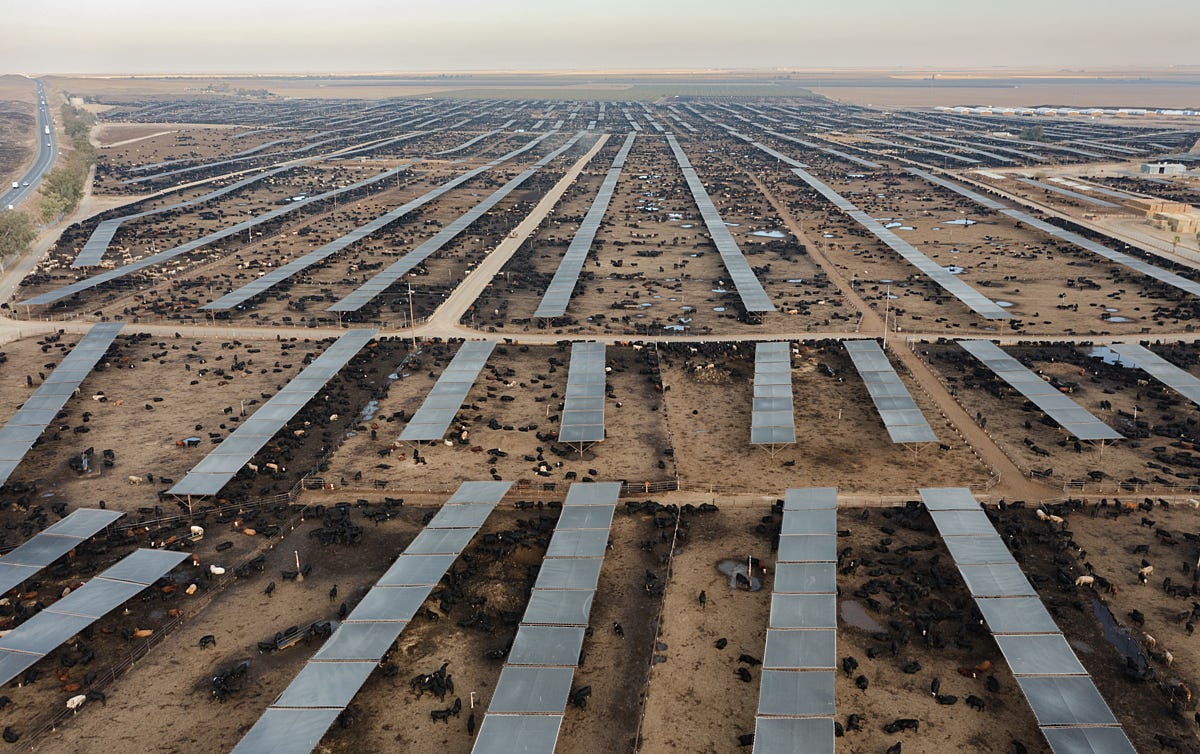
Yet, how is it that another insidious industry that’s been around for more than a century grabs next to no attention at all, megafactories where live animals are made into the meat, eggs, and dairy you eat: born, raised, slaughtered, processed, and shipped to a supermarket near you, where it’s slapped with “all-natural” propaganda. These increasingly high tech, yet ethically antiquated “animal feeding operations” may slip through mainstream media, but they too warrant your outrage, if not your awareness. And, ideally, your action.
Plus, the timing comes together nicely, as I was already planning to address the environmental aspects of making animal foods in conventional factory farming. Which, to remind you, is where most Americans and others get their meat. It’s the fourth essay in this Substack series on agshittification thus far examining ultra-processed foods, all-natural meat, how many animals we eat, and what it all means.
There is no shortage of subjects on which to be shocked, and rightly so. Rather, I nod to the similarities in these two industries—one making data, the other meat—things like water, workers, and the communities where it all happens. Yet my main point is to highlight where the simile ends, because, unlike artificial intelligence making data, animals made into meat need to eat, drink, burp, pee, and poo.
In the end, I hope you’ll find room in your outrage for the nimbiest NIMBY of all: megafactory animal farming.
Big Meat Quaffs Water
Perhaps future Earthlings will one day rise up against the machines, data centers and artificial intelligence guzzling up the planet’s water and polluting the planet, Fifth Industrial Revolution technology gone out of control, and unsustainably so. By the time that happens, factory farming will have imploded or our world population will have been greatly reduced due to some huge antibiotic resistance plague.
Yet here in 2026, and for the foreseeable future, agriculture remains the largest water user globally, accounting for about 72% of freshwater withdrawals, chiefly for irrigation. A substantial share of agriculture’s water footprint is associated with livestock production, including the water required to grow animal feed as well as that used directly by animals and farming operations. CAFOs produce food from live intelligence, an improved yet still inhumane First Industrial Revolution technology spinning out of control—and unsustainably so.
To get into the water issue, you need to go a bit deeper on its three components:
Green water: from atmospheric water like rain, snow, fog
Blue water: extracted groundwater or surface water
Grey water: polluted during production, requiring blue water to dilute and decontaminate for reuse
The extensive use of blue water in agriculture is already unsustainable, as the rate of withdrawal from aquifers currently exceeds replenishment. Big Ag is the biggest driver, and meat and other animal foods have much higher blue water and grey water footprints compared to plants.
And it’s not only because of the obvious reasons, that animals need to drink water to live and to be cleaned. An even bigger water cost is due to the massive amount of water needed to grow corn, the main crop fed to cows and other animals. Corn is a very thirsty plant, the single most irrigated crop in America, and it’s all those cornfields that explain beef’s 42% increase in water footprint between 1990 and 2015.
For all these reasons, the water footprint per calorie for beef is 20 times higher than cereals and starchy root vegetables. Similarly, the footprint per gram of protein for milk, eggs, and chicken was about 50% larger than for beans, peas, and lentils. Fresh vegetables and fruits have the lowest water footprints, largely driven by their low blue water use.
There are no data I know of comparing the water footprint of your burger with, say, the time you spent sexting with a chatbot—or running your business with agentic AI. I’m going to go ahead and speculate that it’s dwarfed by that used in factory farming, by far.
Big Meat Devours Land
To set the planetary scale for the true cost of your steak and eggs, Earth is about 71% water and 29% land; 76% of the land is habitable. About half of that habitable land is used in agriculture as a whole and—wait for it—80% of that is used in animal farming for grazing and feed production. Cows are an exemplar.
Much of the habitable land on Earth is full of trees, lush green forests that play an integral role in our planet’s ecosystem. Forests are required for replenishing groundwater supplies that are vital for life as we know it, not just for human hydration and agriculture but for many other industrial and human uses and livelihoods. Forests are also crucial for soil health and biodiversity: More than half of all terrestrial animals, plants, and insects live in forests. There are, moreover, millions of human forest dwellers who rely upon it for food and livelihoods: they too are at risk.
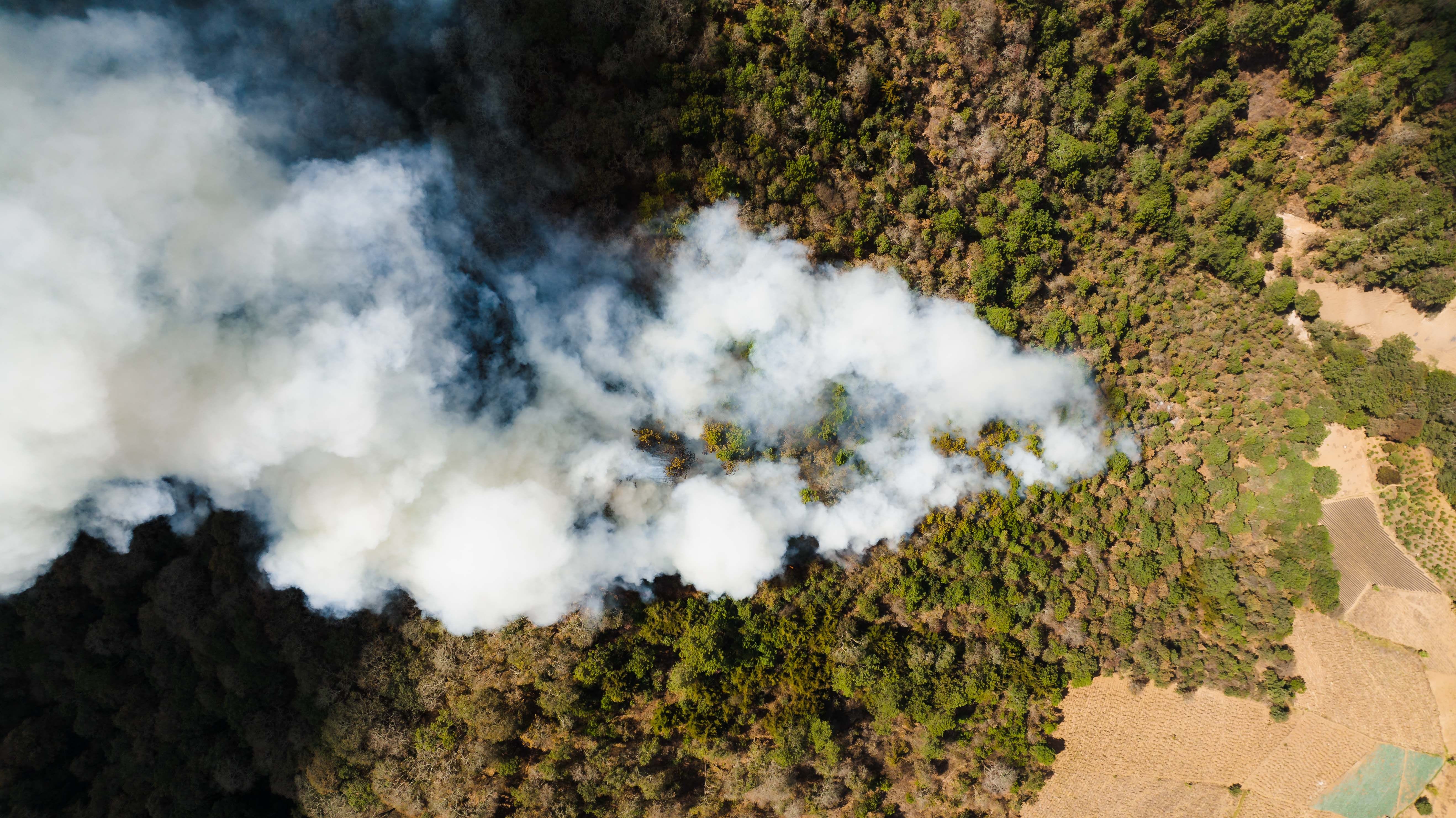
Our global meat habit, driven by the spread and escalation of all-American factory farming, means hacking down a whole lot of trees. Like, say, massive portions of the Amazon rain forest to graze cows and grow cow food to make cow food.
(Catch that?)
The process is aptly called deforestation, which destroys one of Earth’s critical carbon sinks. That’s because trees absorb carbon dioxide (CO2), removing it from the air ergo its warming effect on the atmosphere. Until it’s all released back into the environment as they’re slashed down to make cows into meat. Following fossil fuel consumption, deforestation is the second leading source of excess atmospheric CO2, the most abundant greenhouse gas (GHG) directly responsible for anthropogenic global warming.
By some accounts, humanity’s most visible mark on our planet is the transformation of wild habitats into farmland. In just one millennium, we’ve gone from using 4% for farming to 44%—which explains why food production to feed a growing human population has been the largest driver of biodiversity loss around the world.
How this measures up against data centers is complex, its metaphor drifting too far afield from my focus on factory farms. Both industries sprawl across the land and each produces environmental waste and pollution. But only one of them involves live animals, with all that entails, its true footprint extending far from the factory complex and onto the fertilizer-laden crops to feed billions of animals and dispose of their waste.
Corn-Fed Climate Change
Global warming is just one piece of a larger constellation of environmental conditions that we now call climate change, a result of three greenhouse gases (GHGs). Carbon dioxide (CO2) is the biggest contributor (76%) due to deforestation and fossil fuel consumption. The lesser known GHGs responsible for Big Meat’s carbon footprint are methane (CH4) and nitrous oxide (N2O), at around 16% and 6%, respectively. For context, about one-third of emissions comes from the agrifood system, which operates animal factories and grows crops and processes and packages and distributes foods of all kinds, all around the world.
Soil requires specific nutrients to grow crops, especially nitrogen (N), traditionally from manure, guano, and the like. But the creation of N-based fertilizers in the early 20th century allowing direct application to soil indelibly altered the course of agriculture: Synthetically produced fertilizer improves productivity and coaxes higher crop yields for a given area of land—until they don’t—while polluting air, land, and water alike. Big Ag is still the single largest source of N2O globally. And, while only 6% of agricultural GHG emissions are from nitrous oxide, it has about 300 times the global warming power (GWP) of CO2.
And, guess what? A substantial amount of fertilizers are used to make cow food, which is grass and corn (which is not a normal part of the bovine diet, but it’s cheap feed). Corn is a big part of the climate change problem, since conventional farmers fertilize the hell out of it. Synthetic fertilizer use has risen dramatically in the past several decades—commensurate with the growth of corn-stuffed cows.
Also, cows burp. A lot. And fart. Because they’re animals. You’ve probably heard all about it by now: Cows are ruminant animals that digest cellulose in a process called enteric methanogenesis, its gaseous by-product—methane—excreted through the mouth. That burp is a greenhouse gas with about 27-30 times the global warming power (GWP) of CO2.
See how it’s all related?
Enjoy that all-natural steak, bro.
Manure Lagoons, Lakes of Shit
As the wealthiest and most wasteful sapiens metaphorically shit on the planet daily with unsustainable practices, our literal shit is flushed down a toilet, handled with public health infrastructure and regulations for handling human waste hygienically and safely.
While some regulations exist for the more than 2 trillion pounds of shit produced annually in the US from animal farming—roughly 13 times the amount from American bums—they are, by most accounts, insufficient, inconsistent, and weakly enforced.
Globally, livestock are estimated to produce twice as much waste the amount of the entire human population.
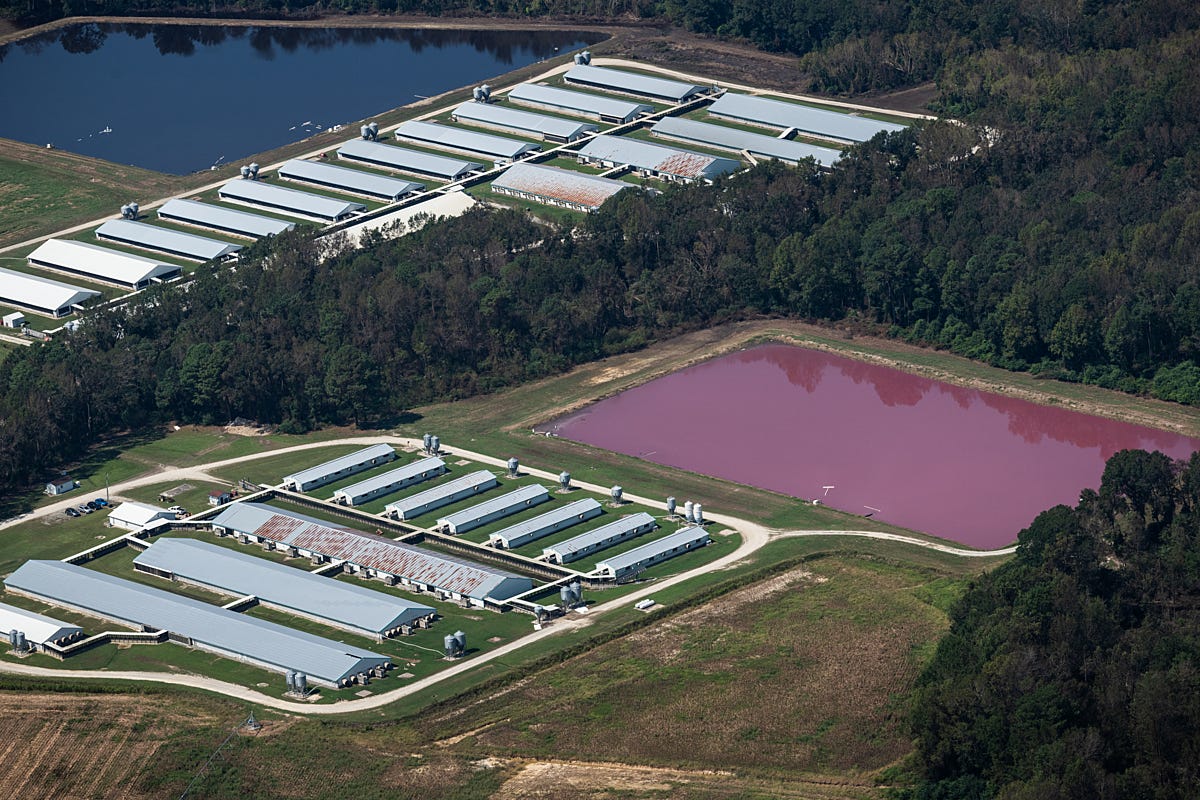
Animal waste management varies across species; the size and amount of shit varies, and all. In general, animal waste is typically stored in open pits, that is, lakes of shit; the industry prefers the euphemism manure lagoons. (Also: massive sheds, for chickens, or poop simply heaped haphazardly upon the land.)
Unsurprisingly, these giant basins of animal waste dotting the rural landscape often leak, spill, or leach into the environment, their waste potentially carrying pathogens like E. coli, pesticide and fertilizer residues, antibiotic resistant microbes, and other contaminants. Groundwater becomes unsafe for drinking, while rivers contaminated with factory farm waste threatens aquatic life. And can your brain even begin to conjure the smell? Beyond the stench, the airborne pathogens, noxious gases, and dust also increase the risk of respiratory illnesses in these neighborhoods, who are no match for Big Meat’s megafactory farms.
There is no NIMBY for these folks, just trying to live their life and raise their families.
And there is no NIMBY for the folks ultimately responsible for the final step in making animals into meat on the slaughterhouse floor.
Workers at the End of the Line
Around half a million people work in the meatpacking industry, officially termed “animal slaughtering and processing” by the United States Department of Agriculture (USDA). And it’s still among the most dangerous jobs in America, with a high mortality rate, a result of traumatic injuries from dangerous machines and tools used to slaughter animals, often fatal.
Most meatpackers are immigrants and people of color living in poverty in rural counties; they are underpaid, exploited, and lack health insurance and job security. The COVID pandemic highlighted some of the industry’s more deplorable practices, when meatpackers were forced to report to their jobs to get you your meat, but health and human rights violations are not uncommon.
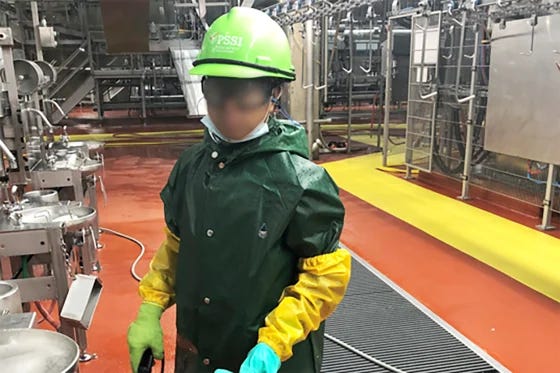
In 2023, for example, Packers Sanitation Services illegally employed more than 100 children to clean poultry and meat processing plants. They were caught and sued—and paid a paltry $15,138 fine per child. Note that child labor is banned by the United Nations as a human rights violation—yet some immigrant children willingly do the work in order to support their families, taking jobs other Americans don’t want.
And so it continues, unabated.
In 2025, federal investigations found that major meat companies like JBS and Perdue also recruit migrant children to perform dangerous overnight cleaning work in slaughterhouses, leading to additional multimillion‑dollar settlements. At the same time, states like Iowa have moved to weaken protections by allowing younger teenagers to work in meatpacking plants, rolling back Fair Labor Standards Act safeguards and making it easier for children to be hired.
From Shitty Practices to Dead Zones
Long after you’ve finished your meal, the ramifications of our global meat fetish continue to reverberate across the planet, leaving indelible impacts on Earth’s land, air, and water.
But make no mistake. Animal feeding operations and concentrated animal feeding operations were polluting the planet long before global warming and climate change entered the collective consciousness. In 1972, the Clean Water Act was passed to address Big Meat’s pollution problem, part of a set of 20th-century regulations that were the hallmark of the modern environmental movement.
Yet agriculture still pollutes water just as furiously as it guzzles it down: Animal farming remains in the top three causes of degrading water quality, globally, disrupting other species and ecosystems as its industrial waste products move downstream—literally and metaphorically. Excess N contributes to air pollution and soil erosion, while chemicals of all kinds eventually leach into groundwater or run off the land before they’re absorbed, which is how they end up in waterways. National Geographic explorer Fen Montaigne provides critical perspective:
The Mississippi River is like a drainage system for your street, but it connects 31 U.S. states and even parts of Canada. These nutrients are ultimately funneled into the Gulf of Mexico, sometimes traveling more than 1,000 miles downstream to start a chain of events in the Gulf that turns deadly.
Ergo the (again) aptly named “Dead Zones,” and there are an estimated 400-500 around the world. Globally, waters low in oxygen (hypoxia) have increased tenfold in the past 50 years—and about thirtyfold in the US. The hypoxic zone in the Gulf averages around 4,400–4,800 square miles—about the size of New Jersey or Connecticut—and the five‑year average remains more than twice the official target of 1,900 square miles.
Factory Farming is a Dead End
It’s a pretty dark ending for this essay, albeit apropos: Death is bludgeoned into the industry, the literal end of the meatpacking line, left in its wake ecosystem destruction, environmental degradation due to pollution of water, land, and air; biodiversity loss, and, of course, escalating climate change. (And chronic disease. And I could go on.)
And guess what?
Everything, all of it, farm to fork and far beyond, it’s getting worse and worse. That’s why my next newsletter will round up some of the significant changes happening in food, nutrition, and agriculture policy highlighting the increasingly inhumane and unnecessary animal farming industry.
Every day, every minute, under the current administration doubling down on megafactory farming while dismantling science-based public health policy protecting humans and our environment—not to mention animal welfare and meatpackers.
So I return to you, here, with my initial plea, as it often seems to me we sapiens sometimes miss the forest for the trees, ignoring the grotesque meat-making industry you’re not meant to think about, let alone see.
Probably because all those trees have been chopped down to make your burger.
When all is said and done, I hope you’ll agree with me, and let slide the hyperbole:
I’ll take factories making data over factories making meat any day and every day of every fucking week.
What do you think?
We all choose our battles, but in the current world order where so much feels out of our own control, perhaps you’ll join me in exerting whatever agency we do have by considering your diet a vote with your fork for the kind of world you wish to see. I invite you to share the food truth, and subscribe to be part of the revolution. It’s free, and there will never be a paywall.
SOURCES
Newby PK. Food and Nutrition: What Everyone Needs to Know. New York: Oxford University Press, 2025. https://foodmattersmedia.com/food-and-nutrition/book-overview/
Brooks E. The one town that wants a data center: The YIMBYism of Jay, Maine. The Atlantic. August 3, 2026. https://www.theatlantic.com/technology/2026/08/jay-maine-wants-data-center/688043/
Food and Agriculture Organization of the United Nations. Agricultural water management: water accounting.
https://www.fao.org/land-water/water/agricultural-water-management/water-accounting/enMekonnen MM, Hoekstra AY. A global assessment of the water footprint of farm animal products. Ecosystems. 2012;15:401–415.
https://doi.org/10.1007/s10021-011-9517-8Richter BD, Bartak D, Caldwell P, et al. Water scarcity and fish imperilment driven by beef production. Nature Sustainability. 2020;3:319–328.
https://doi.org/10.1038/s41893-020-0483-zFood and Agriculture Organization of the United Nations. Statistical Yearbook: World Food and Agriculture 2023.
https://www.fao.org/3/cc8166en/cc8166en.pdfRitchie H, Roser M. Half of the world’s habitable land is used for agriculture. Our World in Data. February 16, 2024.
https://ourworldindata.org/global-land-for-agriculturePoore J, Nemecek T. Reducing food’s environmental impacts through producers and consumers. Science. 2018;360(6392):987–992.
https://doi.org/10.1126/science.aaq0216Ritchie H. What are the carbon opportunity costs of our food? Our World in Data. March 19, 2021.
https://ourworldindata.org/carbon-opportunity-costs-foodFood and Agriculture Organization of the United Nations. The State of the World’s Forests 2020: Forests, Biodiversity and People.
https://www.fao.org/state-of-forestsBenton TG, Bieg C, Harwatt H, Pudasaini R, Wellesley L. Food System Impacts on Biodiversity Loss: Three Levers for Food System Transformation in Support of Nature. Chatham House; February 2021.
https://www.chathamhouse.org/2021/02/food-system-impacts-biodiversity-lossFood and Agriculture Organization of the United Nations. Greenhouse gas emissions from agrifood systems: Global, regional and country trends, 2001–2023. October 29, 2025.
https://www.fao.org/statistics/highlights-archive/highlights-detail/greenhouse-gas-emissions-from-agrifood-systems.-global--regional-and-country-trends--2001-2023/enIntergovernmental Panel on Climate Change. Climate Change 2021: The Physical Science Basis. Contribution of Working Group I to the Sixth Assessment Report. 2021.
https://www.ipcc.ch/report/ar6/wg1/U.S. Environmental Protection Agency. Understanding global warming potentials.
https://www.epa.gov/ghgemissions/understanding-global-warming-potentialsUwizeye A, de Boer IJM, Opio CI, et al. Nitrogen emissions along global livestock supply chains. Nature Food. 2020;1:437–446.
https://doi.org/10.1038/s43016-020-0113-yPeterson J. How animal agriculture is accelerating global deforestation. Earth.org. February 22, 2024.
https://earth.org/how-animal-agriculture-is-accelerating-global-deforestation/
Eshel G, Shepon A, Makov T, Milo R. Land, irrigation water, greenhouse gas, and reactive nitrogen burdens of meat, eggs, and dairy production in the United States. Proceedings of the National Academy of Sciences. 2014;111(33):11996–12001.
https://doi.org/10.1073/pnas.1402183111Food and Agriculture Organization of the United Nations. The State of Food and Agriculture 2023.
https://www.fao.org/documents/card/en/c/cc7724enU.S. Environmental Protection Agency. Animal Feeding Operations. Updated December 12, 2025.
https://www.epa.gov/npdes/animal-feeding-operations-afosU.S. Environmental Protection Agency. Literature review of contaminants in livestock and poultry manure and implications for water quality.
https://www.epa.gov/npdes/animal-feeding-operations-afosNational Association of Local Boards of Health. Understanding Concentrated Animal Feeding Operations and Their Impact on Communities. 2010.
https://www.cdc.gov/nceh/ehs/docs/understanding_cafos_nalboh.pdfThu KM. Public health concerns for neighbors of large-scale swine production operations. Journal of Agricultural Safety and Health. 2002;8(2):175–184.
https://doi.org/10.13031/2013.8431U.S. Department of Agriculture, Economic Research Service. The meatpacking industry in rural America during the COVID-19 pandemic. Updated May 13, 2021.
https://www.ers.usda.gov/covid-19/rural-america/meatpacking-industryU.S. Bureau of Labor Statistics. Injuries, illnesses, and fatalities: animal slaughtering and processing.
https://www.bls.gov/iif/Dreier H. Alone and exploited, migrant children work brutal jobs across the U.S. The New York Times. February 25, 2023.
https://www.nytimes.com/2023/02/25/us/unaccompanied-migrant-child-workers-exploitation.htmlSemuels A. Over 100 kids were illegally employed in dangerous meat packing plant jobs. Time. February 17, 2023.
https://time.com/6256728/meatpacking-child-laborU.S. Department of Labor, Wage and Hour Division. More than 100 children illegally employed in hazardous jobs, federal investigation finds; food sanitation contractor pays $1.5M in penalties. February 17, 2023.
https://www.dol.gov/newsroom/releases/whd/whd20230217-1Natanson H. It’s suddenly legal for kids to work in meatpacking plants. The Washington Post. July 6, 2023.
https://www.washingtonpost.com/business/2023/07/06/iowa-child-labor-law-meatpackingU.S. Department of Labor. Child labor in slaughterhouses spotlighted by 3 settlements totaling $8.4 million. January 16, 2025.
https://www.dol.gov/newsroom/releases/whd/whd20250116Valencia Weber C, et al. Meatpacking companies to pay $8 million for U.S. child labor violations. The New York Times. January 16, 2025.
https://www.nytimes.com/2025/01/16/us/child-labor-meatpacking-jbs-perdue.htmlFood and Agriculture Organization of the United Nations. Water pollution from agriculture: a global review. 2017.
https://www.fao.org/3/i7754e/i7754e.pdfDiaz RJ, Rosenberg R. Spreading dead zones and consequences for marine ecosystems. Science. 2008;321(5891):926–929.
https://doi.org/10.1126/science.1156401National Oceanic and Atmospheric Administration. Below average summer 2025 “dead zone” measured in Gulf. July 31, 2025.
https://coastalscience.noaa.gov/news/below-average-summer-2025-dead-zone-measured-in-gulf/U.S. Environmental Protection Agency. Literature Review of Contaminants in Livestock and Poultry Manure and Implications for Water Quality. 2013.
https://nepis.epa.gov/Exe/ZyPURL.cgi?Dockey=P100H2NI.TXTNational Oceanic and Atmospheric Administration. The dead zone in the Gulf of Mexico. Ocean Today. Accessed July 30, 2026.
https://oceantoday.noaa.gov/deadzonegulf/