

Climate Week Needs a Dirtier Word
Food is one of the official themes of this year’s annual Climate Week in New York City, and there’s a full slate of programming featuring many of my colleagues and others striving to create a healthy, more sustainable food system on the front lines. The unfiltered food truth I offer here doesn’t always get me invited to such things, turns out.
Wouldn’t be the first time.
(Likely won’t be the last.)
It’s unfortunate, though, since what is often missing from the polite parlance of diplomatic discourse is the potent prose needed to create the paradigm shifts that change the world.
And, sometimes, that calls for profanity.
So, since I’m not schmoozing at a fancy five-course dinner in Manhattan right now, I offer to you in this space today a one-word commentary, a foul-sounding phrase that captures the putrid state of the global agrifood system, a portmanteau that reflects the cause and consequence of a soul-sucking industry that continues to threaten people, the planet, and all its inhabitants.
I’m through pulling punches; I’m calling a spade a spade:
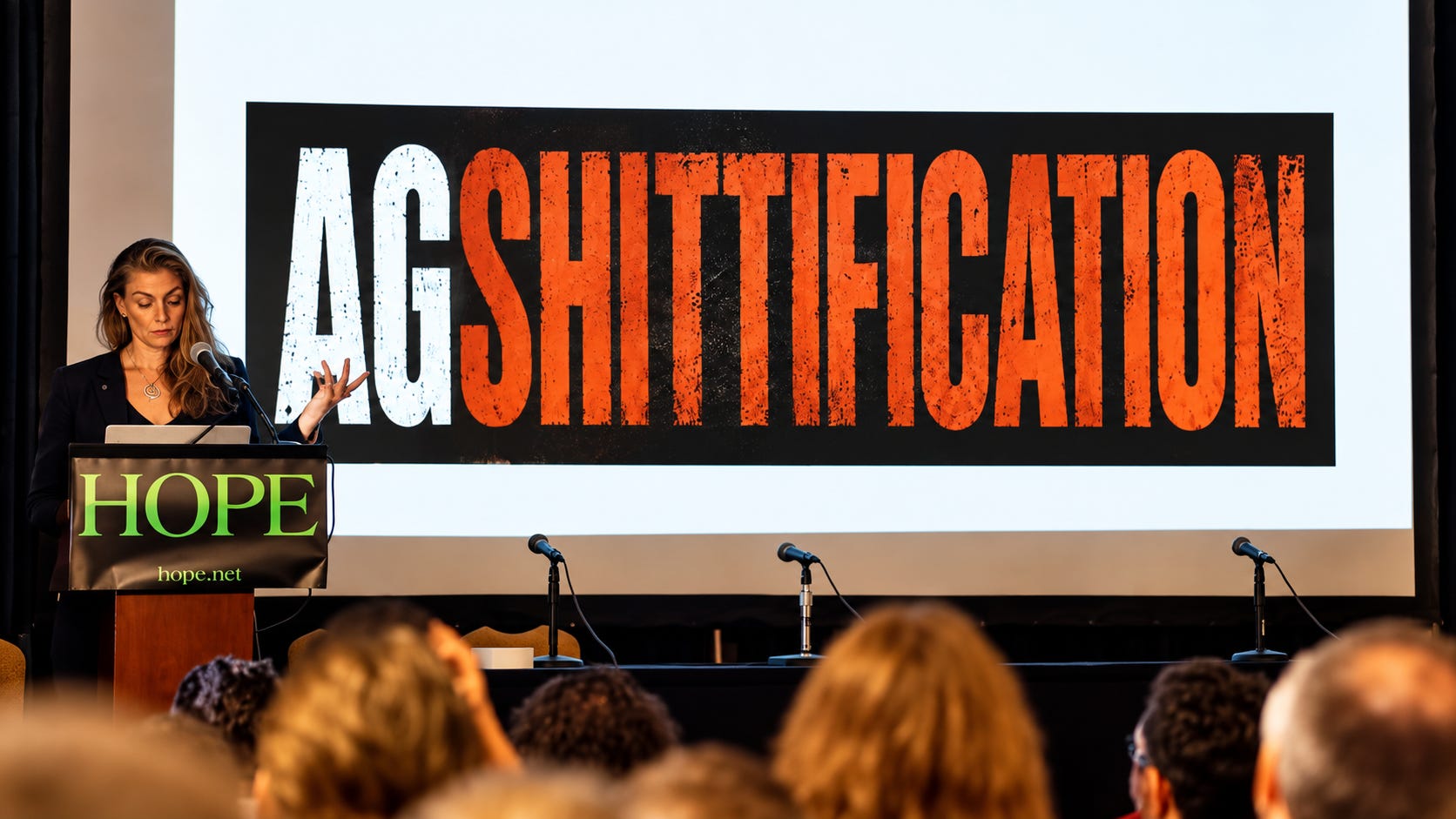
The word is agshittification—see it right there on the screen below?—and it made its stage debut in New York City at HOPE 2026 in August.
Age of the Chicken
The global agrifood system heralded by America and exported around the globe is built on the factory farming of animals—now megafactory farming—so much so that mummified chicken bones in our planet’s crust may just be one of the salient markers of the Anthropocene, a geologic scar our species has left upon the Earth.
(Also: concrete, plastics, and nuclear weapons. And, now, AI.)
Indeed, we are living in the Age of the Chicken by some scientific accounts. And if that sounds ridiculous then I’ll remind you that Americans consume 27 chickens on average, each year, and that 140,000 chickens are slaughtered every single minute worldwide.
Take that in.
If you know what I know, which is why I do what I do, you’ll understand the reasons why the agshittification portmanteau—the enshittification of agriculture—is urgent and necessary.
And not just for our food system.
NO.
The transformation of conventional agriculture is essential for the progress of humanity itself.
To evolve beyond the Age of the Chicken.
What Agshittification Means
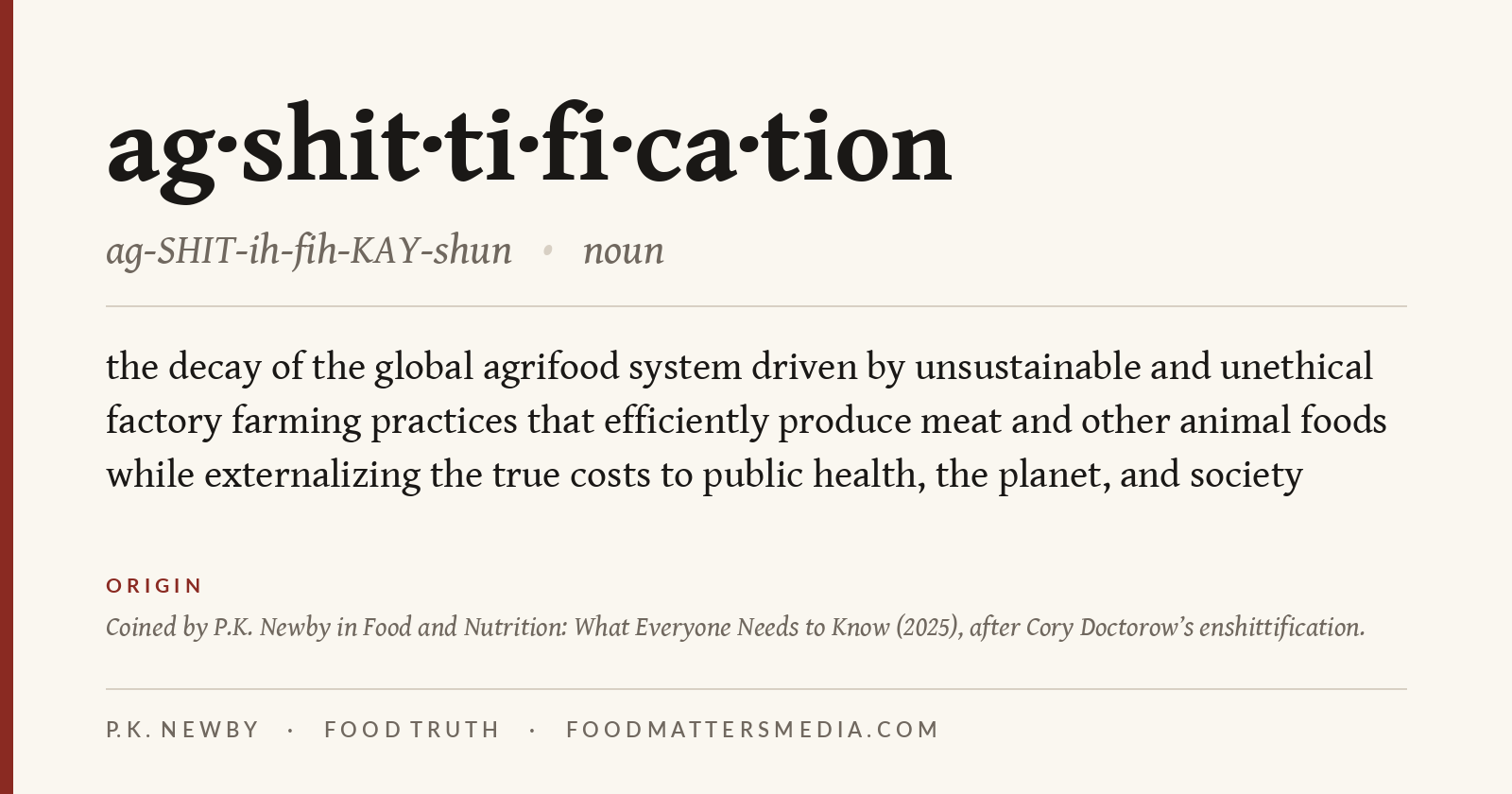
Agshittification captures the decay of the global agrifood system driven by unsustainable and unethical factory farming practices that efficiently produce meat and other animal foods while externalizing the true costs to public health, the planet, and society.
Today, I break down exactly what it means, where it came from, and why the profanity is part of the point, punctuating the wretched practices and impacts of Big Ag when academic phrases like “food polycrisis” just don’t pass muster.
From Enshittification to Agshittification
I penned agshittification while creating my 2025 Oxford University Press book, Food and Nutrition: What Everyone Needs to Know. It’s an obvious play on Cory Doctorow’s addictively mellifluous enshittification, and created with deep homage to its originator. I anticipate you will find these naughty-by-design words as linguistically gratifying as I do.
And I certainly hope you’re already familiar with his word, yes?
In brief, it refers to the decay of digital platforms through practices that take value away from users, then away from business customers, then claw it all back for the owners and shareholders. Think, say, the Big Tech bros we all love to hate, especially in the wake of fifth industrial revolution AI and data centers changing everything we know about pretty much everything.
Cory’s neologism was named word of the year by the American Dialect Society in 2023 and by the Macquarie Dictionary in 2024. He later warned, in the Financial Times:
Enshittification is coming for absolutely everything.
Indeed it has, sir.
Indeed it has.
Cory’s titular 2025 book Enshittification: Why Everything Suddenly Got Worse and What to Do About It puts it all together, and it’s getting more and more public attention on the internet and mainstream press—as well it should. This year, historians are now discussing the term in academic circles, and the word just showed up in the preëminent scientific journal Nature Energy, profanity finally making it past pesky peer review.
I was an early adopter of the word, having learned about it most likely from the supercomputing guru Greg Newby, perhaps sometime in 2023, maybe? My big brother and badass scientist heard it from Cory Doctorow himself; the two knew each other professionally from the HOPE community and digital computing worlds.
But it wasn’t until sometime in the summer of 2024 that the portmanteau AGSHITTIFICATION smacked me in the brain like a big-ass ton of rocks. It was the perfect word to capture everything I’d been researching and writing and thinking and feeling for the two years previous while working on my own book in earnest, often with horror, which was resulting in profound existential angst.
And, of course, the animal farming industry includes colossal piles and lakes of literal shit.
Agshittification.
Agshittification.
Agshittification.
How Big Ag Broke the Food System
If you’ve been reading along here, or have a copy of my book, you already know that the agrifood system is broken, and that industrialized, conventional animal farming is at the root of myriad interconnected crises, climate change to chronic disease. The practice is built on antiquated thinking and cruel technologies that must be left in our past: Today, we have mouthwatering alternatives and mind-bending food technologies that can—and must—render farming live animals for meat obsolete.
And do not fret! You can still have your burger and eat it, too.
I’ll get into what I mean by that, along with other facets of a healthy, sustainable diet, in a later essay. Until then, you may recall that I launched Substack in the winter of my discontent, when I took on RFK Jr.’s bullshit Dietary Guidelines for Agribusiness. My disgust led me into a deep dive into food processing, positing that meat is the most ultra-processed food out there.
But make no mistake: I’m not the only one disgusted by the disinformation-laden propaganda coming from the carnivore bros in the White House and their Big Ag cronies. The 2025–2030 (faux) Dietary Guidelines drew immediate objections from many other nutrition scientists and experts, especially regarding their absurd emphasis on meat and dairy, the antithesis to decades of evidence-based diet advice, a clear reflection of obvious industry influences from Big Meat and Big Dairy running the factory farms.
In August 2026, the Physicians Committee for Responsible Medicine sued the US Department of Health and Human Services and the US Department of Agriculture to withdraw the guidelines, which they’ve done in the past to call out the blatant special interests lauding all-American meat and milk. It’s just more egregious this time around, as with pretty much everything in the United States: Anti-science misinformation is just another chapter in the agshittification playbook.
And it’s becoming even worse, almost daily, it seems.
20,000 Cases of Explosive Diarrhea
If Big Ag facts aren’t quite getting through to you, maybe consider it from the perspective of the unfortunate Americans who experienced gut-wrenching diarrhea caused by the recent cyclosporiasis outbreak.
Were you one of them?
The majority of cases in the largest such outbreak ever recorded in the country were traced to a foodborne pathogen found in shredded iceberg lettuce, turns out, which underscores a crucial point: Agshittification isn’t only about animal farming. While Big Meat plays the leading role in this super shitty play, industrialized agricultural practices growing plant crops share some similar environmental and food safety concerns, depending on how they’re produced and what happens in the supply chain, farm to fork and all of that.
But the risks pale in comparison to animal farming, which creates human foods from live beings who burp, fart, pee, and poo: Agshittification runs on the same economic forces that lead to enshittification, yes, but the word is necessary to emphasize the actual shit at the heart of Big Ag’s meat machine.
Or, in the cyclospora case, perhaps the poop is just your own, resulting in part from slack food safety regulations under the current regime.
(Too soon?)
And here’s the kicker: Most of that nutrient-bereft salad green that is iceberg lettuce was used as filler for your cheap Taco Bell burrito. In July 2026, the US Food and Drug Administration reported:
FDA’s traceback investigation identified convergence on a single supplier, Taylor Farms de Mexico, that provided shredded iceberg lettuce used by Taco Bell locations where sick people ate before becoming ill.
The Profanity Is Paramount
Enshittification was coined in part because of its sweariness, its aim to bring attention to just how much the internet sucks now while describing in detail what happened, why, and how we can fix it. Big tech shares a lot in common with Big Ag, two behemoth industries that play outsized roles in our everyday existence, both in the virtual world and in real life (what Cory cleverly refers to as our “meat bodies”).
I considered simply adapting the concept directly to my own subject matter, of course. But the syllabic ag- to en- swapperoo was simply too spot-on. It’s disturbingly onomatopoetic, for starters, is it not? Like something rotten in the state of agriculture, right?
The fetid food system necessitated a name of its own, you now know. And, like Doctorow, it’s far more than a simple play on words: Agshittification applies profanity not for its own sake—I loathe the word shit—but in order to evoke a visceral response with the requisite disgust owed to a stench both metaphorical and literal.
The profanity is part of the point, and I encourage you to use it whenever you need the perfect way to capture, in a single word, just how shitty everything in the state of Big Ag actually is.
And maybe—especially?—even if you’re sitting at Climate Week.
The Anatomy of Agshittification
Agshittification reflects the state of the global agrifood system, an American-born epidemic running on the myth of all-natural, manly meat (while you’re running to the toilet from the next foodborne pathogen).
Here’s what I know to be true, applying Cory’s epidemiologic lens (my own doctoral-level training, actually) alongside my own nutritional ecology and public health frameworks:
Agshittification has specific causes, rooted in conventional agricultural and industrial animal farming practices and policies that prioritize economic efficiency over public health and everything else.
Agshittification carries severe consequences at the local, national, and planetary levels, impacting human health, climate change, environmental degradation, biodiversity loss, and society itself.
Agshittification is spreading rapidly as global appetites for meat and its association with wealth and class rise, while increasing technological capacity makes it faster and cheaper than ever to produce animal protein.
Agshittificatory policies prioritize profits over public health through decreased competition, deregulation, and subsidies that fuel the bloody machine and make it more horrid for animals and more dangerous for meatpackers.
Agshittification is fueled by misinformation and propaganda in today’s War on Science that obfuscates food truth, most brazenly illustrated in the Dietary Guidelines for Agribusiness.
Agshittification alternatives exist, and an ecotechno future based on ecological practices and ethical innovations is the key to a healthy, sustainable food system for all.
Agshittification in action:
The most grotesque proposals in the US currently call for increasing animal concentration and speeding up slaughter lines while decreasing worker safety regulations and removing environmental protections.
Up Next: The Men Behind Big Meat
The next few posts will continue to illustrate agshittification, starting with a round-up of today’s agshittificatory policies doubling down on factory farming. I’ll also introduce you to a few of the men at the helm of animal farming in the United States during the first Industrial Revolution more than a century ago. You’ll meet John W. Tyson and Arthur Perdue, whose families largely still run the show. You’ll learn about chickenization, the vertical integration of the chicken industry, going back to the early 20th century. You’ll hear about the 1940s American Chicken of Tomorrow Program, too, which is how you got those big, fat, all white meat chicken breasts to your plate.
You’ll also meet Smithfield, the biggest pork producer in the world based in North Carolina, Chinese-owned since 2013: 26-story vertical pig farms are already up and running in China to bring sophisticated eaters their succulent pork belly.
Make no mistake: Pig farms like these are coming one day to a town near you.
And these concentrated animal feeding operations pollute in ways no data center ever will, all part of an agrifood system dedicated to turning living animals into meat. It’s a far cry from AI making sense of data fed to it by humans.
Yet the villain is the same in both industries, and it’s the most dangerous species on earth: Man.
The series will culminate at last with “The Agshittification of America,” just in time for Election Day (assuming we’re all still alive, that is) when we put the whole stinking thing together, a rallying cry for you to vote with your ballot, as well as your fork, for the kind of world you wish to see.
Meanwhile, do not drown in despair, as I myself am wont to do. There are indeed science-backed guidelines about what healthy, sustainable diets actually look like. The incredible news is that alternative food systems and amazing innovations are springing up all around the globe; there is a delicious path forward.
There is hope—there must always be hope!—that, together, we can create a better future of food.
Coming soon: The live video recording of “Agshittification: Big Meat, Misinformation, and the Fight for the Future of Food” (HOPE 2026 at The New Yorker Hotel, New York City, August 2026).
SELECTED SOURCES
Newby PK. Food and Nutrition: What Everyone Needs to Know. 2nd ed. New York: Oxford University Press. 2025. https://foodmattersmedia.com/food-and-nutrition/book-overview/
Climate Week NYC. Food. 2026. https://www.climateweeknyc.org/food
NYC Food Policy Center, Hunter College. Food events at Climate Week NYC 2026: a day-by-day guide. September 2, 2026. https://www.nycfoodpolicy.org/climate-week-nyc-2026-food-events/
HOPE 26. Talks. 2600 Enterprises, 2026. https://www.hope.net/talks/
Doctorow C. Enshittification: Why Everything Suddenly Got Worse and What to Do About It. New York: Farrar, Straus and Giroux. 2025.
Bennett CE, Thomas R, Williams M, et al. The broiler chicken as a signal of a human reconfigured biosphere. R Soc Open Sci. 2018;5:180325. doi:10.1098/rsos.180325 https://royalsocietypublishing.org/doi/10.1098/rsos.180325
How chickens took over America’s dinner plates, in one chart. Vox. February 19, 2021. https://www.vox.com/future-perfect/22287530/chicken-beef-factory-farming-plant-based-meats
Roser M. How many animals get slaughtered every day? Our World in Data. September 26, 2023. https://ourworldindata.org/how-many-animals-get-slaughtered-every-day
2025–2030 Dietary Guidelines face backlash over red meat. FoodNavigator. January 9, 2026. https://www.foodnavigator.com/Article/2026/01/09/20252030-dietary-guidelines-face-backlash-over-red-meat/
Center for Science in the Public Interest. Health and science professionals question scientific basis of 2025–2030 Dietary Guidelines. February 3, 2026. https://www.cspi.org/press-release/health-and-science-professionals-question-scientific-basis-2025-2030-dietary
A critical narrative review appraisal of the 2025–2030 Dietary Guidelines for Americans. March 25, 2026. https://pmc.ncbi.nlm.nih.gov/articles/PMC13074671/
Physicians Committee for Responsible Medicine. Physicians sue government to withdraw Dietary Guidelines for Americans. August 19, 2026. https://www.pcrm.org/news/news-releases/physicians-sue-government-withdraw-dietary-guidelines-americans
Cueto I. Physician group sues Trump administration over dietary guidelines. STAT News. August 19, 2026. https://www.statnews.com/2026/08/19/physician-group-sues-trump-administration-over-dietary-guidelines-food-pyramid-hhs-usda/
American Dialect Society. 2023 Word of the Year is “enshittification.” January 5, 2024. https://americandialect.org/2023-word-of-the-year-is-enshittification/
Macquarie Dictionary. Word of the Year 2024. November 25, 2024. https://www.macquariedictionary.com.au/word-of-the-year/word-of-the-year-2024/
Doctorow C. Enshittification is coming for absolutely everything. Financial Times. https://www.ft.com/content/6fb1602d-a08b-4a8c-bac0-047b7d64aba5 (Behind a paywall.)
Historicising enshittification. MR Online. September 12, 2026. https://mronline.org/2026/09/12/historicising-enshittification/
Smart energy must address enshittification risks. Nature Energy. September 15, 2026. doi:10.1038/s41560-026-02138-y
Record U.S. cyclosporiasis outbreak is over, CDC says. CNBC. September 11, 2026. https://www.cnbc.com/2026/09/11/cdc-record-cyclosporiasis-outbreak-over.html
Massive cyclospora outbreak linked to lettuce declared over. USA Today. September 11, 2026. https://www.usatoday.com/story/news/health/2026/09/11/cyclospora-outbreak-lettuce-over/91705151007/
US Food and Drug Administration. Investigation of Multistate Outbreak of Cyclospora Illnesses: Iceberg Lettuce (July 2026). Updated September 11, 2026. https://www.fda.gov/food/outbreaks-foodborne-illness/investigation-multistate-outbreak-cyclospora-illnesses-iceberg-lettuce-july-2026
Smithfield Foods is owned by China, but pollution and price-fixing are all American. Sentient Media. July 24, 2025. https://sentientmedia.org/smithfield-foods-owned-by-china/
Ma J. High on the hog: skyscraping hi-tech China swine farm produces 1.2 million pigs a year. South China Morning Post. July 2, 2024. https://www.scmp.com/news/people-culture/article/3268839/high-hog-skyscraping-hi-tech-china-swine-farm-produces-12-million-pigs-year
McDonald J, Bradsher K. China’s bid to improve food production? Giant towers of pigs. The New York Times. February 8, 2023. https://www.nytimes.com/2023/02/08/business/china-pork-farms.html
US Department of Agriculture, Food Safety and Inspection Service. Maximum line speed rates for young chicken and swine establishments. 91 Fed Reg 7926. February 19, 2026. https://www.govinfo.gov/app/details/FR-2026-02-19/2026-03227
National Chicken Council. NCC praises USDA announcement updating outdated chicken processing regulations. February 17, 2026. https://www.nationalchickencouncil.org/ncc-praises-usda-announcement-updating-outdated-chicken-processing-regulations/
USDA plan to jack up line speeds at meatpacking plants. Mother Jones. May 7, 2026. https://www.motherjones.com/politics/2026/05/usda-meatpacking-line-speed-increase-requirements-worker-safey-pollution/
Balls to the wall lady